
Most Atlanta storm damage is fully covered. Most homeowners don’t know it.
Every time a hailstorm or severe-wind front rolls through metro Atlanta — and that’s several times a year — thousands of roofs sustain damage that meets the bar for a covered insurance claim. The shingles look mostly intact from the ground. The leak hasn’t shown up yet on the ceiling. So the homeowner assumes there’s nothing wrong, and the roof quietly deteriorates from a covered storm event into uncovered wear-and-tear.
By the time the leak shows up two years later, the storm is forgotten, the claim window has closed, and the homeowner is paying out of pocket for a roof their insurance would have replaced for the cost of a deductible.
The work we do here is the work that fixes that gap. After every major storm we offer free inspections to anyone in metro Atlanta. We climb the roof, document what we find, tell you whether you have a covered claim, and if you do, we walk the rest of the way through the claim process with you — including meeting your adjuster on-site so the damage actually gets recorded.
What counts as covered storm damage in Atlanta
Standard Georgia homeowner’s policies cover roof damage from sudden, identifiable events. The most common in Atlanta:
- Hail damage — Round impact marks on shingles, granule loss exposing the asphalt mat, and fractured shingles. Hailstones don’t need to be huge — 1-inch hail can cause real damage to older shingles, and Atlanta gets 1-inch+ hail multiple times a year.
- Wind damage — Lifted, creased, or missing shingles, typically on the windward slope of the roof. The Atlanta metro regularly sees 60+ mph gusts during severe-thunderstorm season (March through September).
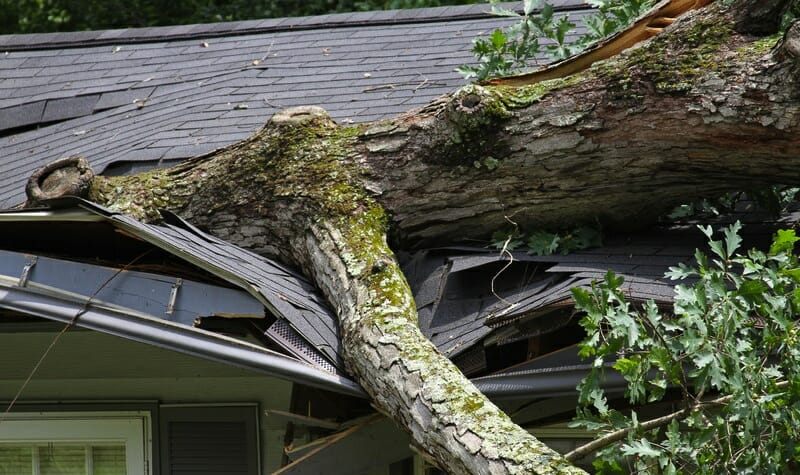
- Fallen tree or limb damage — Direct impact from a tree, large limb, or other debris. Includes the structural damage to decking and trusses beneath the shingles.
- Lightning strike — Direct strikes are rare but covered when they occur. Often accompanied by interior electrical damage.
- Sudden impact — Anything that hits the roof unexpectedly: airborne debris during a storm, a neighbor’s tree falling, even a satellite dish blowing loose.
- Ice damming (less common in Atlanta but possible during winter cold snaps) — Ice buildup at the eaves that forces water back up under the shingles.
What is NOT covered
- Wear-and-tear — A roof reaching the end of its design life is not a covered loss
- Age-related deterioration — Granule loss from sun exposure over 20+ years
- Poor maintenance — Damage that resulted from neglected gutters, clogged valleys, or known-but-ignored issues
- Pre-existing damage — Damage that was there before the storm event
- Manufacturing defects — Those are covered by the shingle manufacturer’s warranty, not your homeowner’s policy
The line between covered and not-covered is sometimes a judgment call by the adjuster. Having a roofer on-site at the adjuster meeting is exactly how borderline cases swing in your favor — we show the adjuster the storm-specific evidence (sharp-edged impact craters, fresh granule loss, directional wind damage) rather than letting them write it off as age.
How our insurance-claim process works
Step 1 — Free roof inspection
You call. We come out, usually within 2 to 5 business days (faster after a named storm event). Lee climbs the roof and inspects every slope, every penetration, the flashing, the gutters, and the visible attic if accessible. Damage is photo-documented with location, count, and severity notes. You get an honest answer: covered claim, partial claim, or not enough damage to claim. No pressure either way.
Step 2 — You file the claim
If we find covered damage, you call your insurance carrier and open the claim. We give you a written summary and photos to attach to the claim filing. You’ll get a claim number and a date for an adjuster to come out.
Step 3 — Adjuster meeting (we’re there)
This is the most important step and the one most homeowners skip. When the adjuster shows up, we’re on the roof with them. We walk them through what we documented, show them the test squares for hail, identify the wind patterns, and make sure they don’t miss anything that should be in the approved scope. Adjusters appreciate it — they get a complete picture in 20 minutes instead of trying to find every issue on their own in 45.
Step 4 — Claim approval & scope
The adjuster sends their report to the carrier. The carrier comes back with an approved scope of work and a settlement amount. We review the scope with you to make sure nothing critical is missing. If the scope is incomplete, we go back to the carrier with documentation supporting the additional items — this is normal back-and-forth, not adversarial.
Step 5 — Installation
Once the scope is finalized, we schedule the work. Full roof replacements are typically 1 to 2 days of on-site work. We protect your landscaping, gutters, and driveway, and we clean up daily. Final walkthrough at completion, photo-documented.
Step 6 — Final payment
On an approved insurance claim, the carrier pays us directly for the approved scope and you simply cover your deductible — there is no separate deposit on insurance work. Standard, non-insurance projects use simple 50/50 terms: half to schedule and the balance once the work is complete and you’re satisfied. Either way, it is all spelled out in your written quote up front.
What we document for the adjuster
The difference between a partial claim and a full claim is usually documentation. Here’s what we put together for every storm-damage inspection:
- Photos of every damaged area, marked with location on the roof diagram
- Test squares for hail damage (10ft by 10ft sections with impact counts on each slope)
- Storm date and event documentation pulled from NOAA / National Weather Service records
- Existing leak documentation if any interior damage has shown up
- Photos of corollary damage to gutters, fascia, soffit, vents, and skylights
- Written scope of recommended repair or replacement
This package gets handed to the adjuster on-site and attached to the claim file. It’s the same documentation an insurance defense attorney would put together — you just don’t need the attorney if the roofer does it upfront.
Timeline — what to expect
- Free inspection — Same week, often within 48 hours after a major storm
- You file the claim — Day of the inspection or day after
- Adjuster visit — 1 to 3 weeks after filing, depending on how busy the carrier is
- Claim approval — 1 to 5 business days after the adjuster visit
- Installation scheduled — 1 to 2 weeks after approval
- Installation — 1 to 2 days for a full replacement, single visit for most repairs
Total: 2 to 6 weeks from your first call to a finished roof. Faster than most homeowners expect, and the vast majority of that time is the insurance company’s queue, not ours.
What to do right now if you think you have storm damage
- Don’t climb the roof yourself. Most homeowner injuries during storm assessment happen from ladder falls or stepping on wind-loosened shingles.
- Document interior damage immediately. Ceiling stains, attic water marks, visible wet insulation — photo it with a timestamp.
- Save the date of the storm. Hail and severe-wind events are logged by NOAA, but knowing the approximate date makes the documentation easier.
- Call us for a free inspection. If we find damage, we’ll tell you. If we don’t, we’ll tell you that too.
- If active leak — call (404) 671-4451 directly. We get a tarp on the roof same-day or next-day depending on weather.
Why LB Roofing for the insurance claim
- Thousands of Atlanta storm-damage claims handled since 2008
- Owner Lee Marcum is on every inspection and every adjuster meeting — not a sales rep, not a subcontractor
- 17 years of relationships with the local adjuster network — they know our documentation and trust the work
- 5-year workmanship warranty in writing on every claim repair, double the industry standard
- $1M liability insurance — certificate of insurance available on request
- BBB A+ Top Tier — 17 years unblemished record
- No separate deposit on insurance work — the carrier pays the approved scope, you cover your deductible
- 4.8 stars across 63+ verified Google reviews
Frequently asked questions — Atlanta storm-damage claims
Free inspection. On-site adjuster meeting. On insurance claims, no deposit from you. The standard LB has held since 2008.